
The Key to Truly Personalized Hearing
Many people believe that once a hearing aid is programmed, the process is complete. The device is set, and the patient simply begins wearing it.
But hope is not a strategy for optimal hearing care. Precision, on the other hand, makes all the difference.
This is precisely where real-ear measurement (REM) becomes so important. REM is a vital verification method that guarantees your hearing aids are providing precisely what your unique ears require.
Here, we will explain what REM involves, why it is truly essential, and what it signifies for your daily hearing clarity. Consider this your well-deserved, in-depth understanding of personalized hearing.
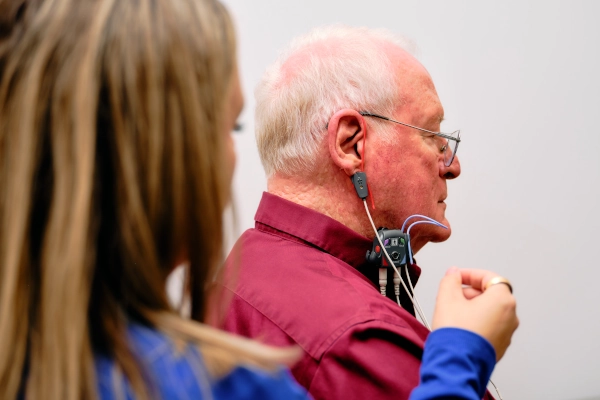
What Is Real-Ear Measurement?
Real-ear measurement offers an objective and accurate method for us to determine how effectively your hearing aids are performing inside your ear canal.
This is not about measurements taken in a sterile test box or a laboratory setting, but rather within the unique, real acoustic environment of your own ear anatomy.
We carefully position a tiny, slender microphone in your ear, right beside the hearing aid, allowing us to precisely measure the sound you are receiving. Based on this data, we are then able to adjust your hearing aids to perfectly align with the specific, data-driven requirements identified by your comprehensive hearing test.
In essence, REM transforms your hearing aid fitting from a process of estimation into one of data-driven accuracy and unparalleled personalization.
Why Does Real-Ear Measurement Matter?
When we initially program your hearing aids, we begin with the manufacturer’s recommended settings. Our process does not conclude there, however.
We incorporate additional refinements based on the comprehensive results of your hearing test, and we make further adjustments drawing from our extensive experience and expertise.
Yet, it is crucial to understand that every ear canal is distinct — they can be long, short, wide, narrow, curved, or angled. These anatomical differences significantly influence how sound travels and behaves within your ear.
This is why, without the benefit of real-ear measurement, the sounds your hearing aids deliver to your eardrum may not precisely align with what your ears truly require. The unique contour of your ear canal impacts sounds in ways that are simply impossible to predict without direct measurement.
With REM, we have the capability to meticulously fine-tune your settings, thereby ensuring that what you hear precisely corresponds to what you need to hear for optimal understanding.
Research consistently demonstrates that fittings verified with real-ear measurement lead to:
- Enhanced speech clarity
- More rapid adaptation to your new devices
- Fewer subsequent adjustment appointments
- Greater long-term satisfaction with your hearing experience
This truly represents the distinction between a hearing aid simply functioning and one that is fully optimized for your personal well-being.

How Real-Ear Measurement Works
Our process is straightforward and focuses on your comfort and accurate results.
Gentle Microphone Placement
A minuscule, flexible microphone is carefully and gently positioned within your ear canal. This step is completely safe, comfortable, and takes only a moment.
Calibrated Speech Signal Playback
We then introduce a precisely calibrated test signal. This signal is expertly designed to accurately replicate the nuances of everyday speech.
Precise Sound Measurement
The delicate microphone captures exactly how sound behaves and interacts within your ear canal. This includes observing how sounds reflect, vibrate, and are naturally amplified by your unique anatomy.
Comparison to Personalized Targets
The detailed response measured by the microphone is then meticulously compared against the specific, evidence-based targets derived from your individual hearing test results.
Real-Time, Expert Adjustment
We then expertly fine-tune your hearing aids in real time until the measured response perfectly aligns with your recommended targets. This meticulous adjustment ensures that you are consistently receiving the precise and appropriate amplification across all necessary frequencies.
This truly represents personalization at its most meaningful level, directly impacting the quality of sound your unique brain receives.
What You Can Expect During This Process
Patients frequently tell us that REM is remarkably simple, and in many instances, quite reassuring.
- It is a painless procedure.
- The entire process requires only a few minutes.
- You will perceive the beneficial changes immediately.
- You depart with the confident understanding that your hearing aids have been precisely fitted to your individual needs, rather than to a generalized average.
Witnessing your own personalized sound measurements displayed on screen can be a profoundly insightful moment.
Many individuals experience a significant boost in confidence the instant they understand the exact improvements that have been made.
Why Some Practices Do Not Use REM (And Why It Matters)
One might expect every hearing care practice to employ REM. Regrettably, this is not yet the universal standard. The reasons include:
- The necessary equipment requires a significant investment.
- The process requires additional, dedicated time during appointments.
- It demands specialized, ongoing training for clinicians.
- It can be simpler to select settings that are merely “close enough.”
But we firmly believe that “close enough” is simply not good enough — not for optimal clarity, true comfort, or long-term success with your hearing devices.
If you have experienced challenges with hearing aids before, the absence of REM may have been a contributing factor.

Frequently Asked Questions
Got questions?
We’ve got answers and we’re standing by to help.